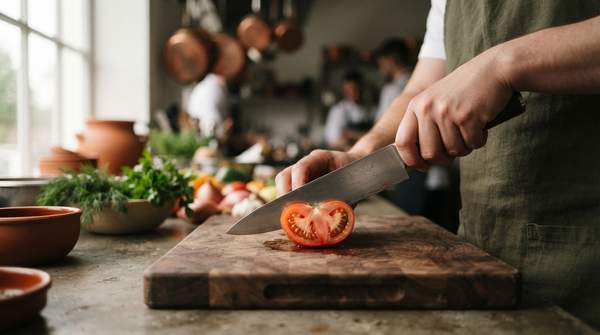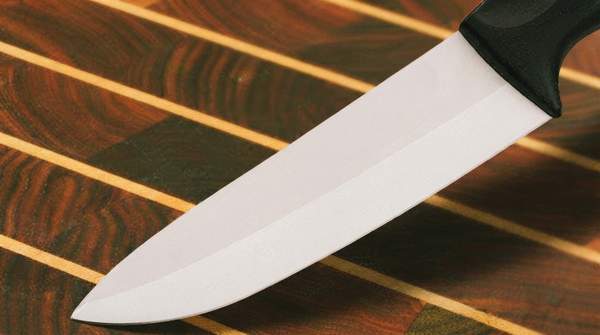
Here's the short answer: a ceramic knife holds its edge far longer than steel, never rusts, and won't brown your produce—but it's brittle, it can't handle bones or hard rinds, and you can't sharpen it with the whetstone or rod sitting in your drawer. Steel remains the all-rounder; ceramic is a specialized tool. Whether it belongs in your kitchen depends on what you cut every day and how much maintenance you're willing to outsource.
Ceramic vs. Steel: A Quick Comparison for Home Cooks
Stainless steel and carbon steel are the most common blade materials in home kitchens, as the team at Culinary Ambition explains, with stainless offering corrosion resistance from its chromium content and a wide range of alloys balancing hardness and toughness. Ceramic blades, by contrast, are made from zirconium oxide—Zirconia—a material originally developed for applications where metals failed. A reviewer at Chefs Resources puts the difference in numbers: Zirconia measures 8.2 on the Mohs hardness scale, versus 5–6 for steel and 10 for diamond. That single number drives almost everything that follows.
Ceramic vs. Steel Kitchen Knives: Performance & Maintenance Trade-offs
The table below lines up the two materials side by side, drawing on hands-on testing and material reviews.
| Attribute | Ceramic Knives | Steel Knives |
|---|---|---|
| Edge Retention | Extremely keen, long-lived edge thanks to Zirconia's hardness; needs sharpening infrequently | Requires more frequent sharpening to stay at peak sharpness |
| Toughness / Brittleness | Hard but brittle with no flex; prone to chipping or breaking, especially with twisting or drops | More durable and resilient; better suited to general-purpose kitchen work |
| Corrosion Resistance | Chemically inert—won't rust or react with food | Stainless steel resists corrosion and staining via chromium; carbon steel needs more care |
| At-Home Sharpening | Nearly impossible with typical equipment; requires diamond abrasives or professional service | Whetstones, rods, and home sharpeners all work well |
| Ideal Tasks | Delicate slicing of soft, boneless foods | Everything else, including hard ingredients and twisting cuts |
Read that table once and the trade-off is obvious: you're choosing between edge life and durability, and between convenience and maintenance independence.