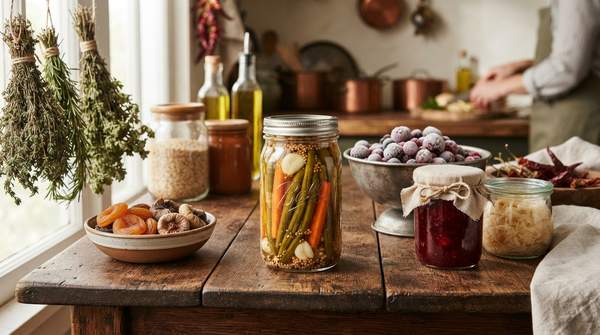
Every home preservation technique, from sun-dried tomatoes to a shelf of sealed pickles, comes down to one elegant idea: change the environment so the processes that spoil food can no longer proceed. Whether you're pulling moisture out, dropping the temperature, or raising the acidity, you're not adding magic—you're manipulating chemistry. Michigan State University Extension puts the logic plainly: preserving food safely starts with deciding what you want to preserve and then finding a research-based recipe that tells you which method fits. This guide explains the science behind why those methods work, so the steps in your recipe stop looking arbitrary and start looking inevitable.
The Core Enemies of Fresh Food
Fresh food is under siege from the moment it's harvested. The primary adversary is microbial: bacteria and other microorganisms colonize food and multiply, and as the David Suzuki Foundation summarizes, preservation works by slowing or eliminating the growth of these spoilage-causing organisms. A second enemy is the food's own chemistry—natural decay processes that break down nutrients over time. USDA's canning guidance notes that many vegetables begin losing vitamins as soon as they're picked, with nearly half potentially gone within days unless the produce is cooled or preserved.
What makes these enemies dangerous is that they all need favorable conditions: warmth, available water, and a hospitable pH. Preservation doesn't fight the microbes directly so much as evict them from their comfort zone. Every technique in this article is a different way of doing that eviction—removing something the spoilers need, or adding something they can't tolerate. Once you see each method as an environmental intervention, the whole field snaps into focus.
Understanding Preservation Principles
The three levers are moisture, temperature, and acidity. Drying pulls the water out of food, taking away the element bacteria need to grow, as MSU Extension explains. Freezing drops the temperature low enough that microbial growth and decay reactions slow dramatically. Pickling lowers the pH with an acidic solution like vinegar or brine, an environment where spoilage organisms simply cannot thrive.
These principles are ancient. The National Center for Home Food Preservation traces active drying of foods to as early as 12,000 B.C. in the Middle East, where sun and wind did the work naturally. Medieval "still houses" used fire heat to dry produce where sunlight was weak, and any climate with freezing temperatures used the cold to store food long before electricity existed. Modern methods, as a review of preservation techniques in the scientific literature observes, industrialized the same ideas—thermal treatment, canning, and freezing extended shelf life by controlling pathogens. The equipment changed; the science didn't.