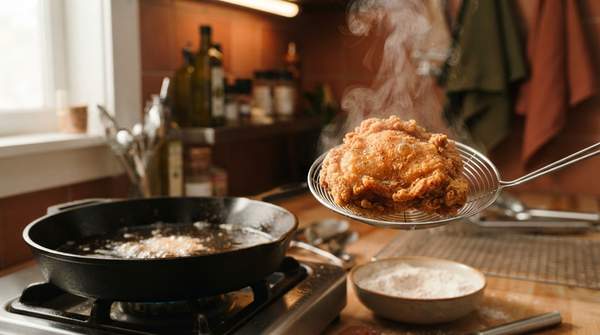
Soggy fried food almost always comes down to one of three failures: too much moisture on the food's surface, oil that isn't hot enough, or steam that gets trapped after frying. Each has a distinct scientific cause, and each has a fix. Once you understand what's actually happening in the pot—the violent conversion of water into steam—you can diagnose your own failures in seconds and correct them, rather than guessing your way through another limp batch.
The Quest for Crispy: Understanding Frying Failures
Here's the frustrating pattern every home cook knows: the first batch of fried chicken is golden and shattering, the second is pale and heavy, and by the time everyone sits down, the whole plate has gone soft. These aren't random misfortunes. Frying is a balance of scientific principles—moisture control, oil temperature, and how you handle food after it leaves the oil—and each stage of the process can fail independently. The good news is that the failures are observable, which means they're diagnosable. Whether your problem is sogginess in the pan, greasiness on the plate, or a crust that collapses during resting, there's a specific physical cause behind it.
The Science of the Sizzle: How Steam Creates Crispness
Fried foods are typically cooked in oil heated to 350–425°F, as the food-science writer behind Decoding Delicious explains. When food hits that oil, it immediately sizzles and bubbles violently—and those bubbles aren't the oil boiling. They're steam shooting out of the food itself: water, which normally boils at 212°F, meets oil heated to nearly twice that temperature and flashes instantly into vapor. This sudden, forceful expulsion of steam is what dries out the outer layer of the food, and once most of that surface moisture is gone, heat travels more quickly toward the center while the crust dries and crisps.
As frying progresses, the bubbles become fewer and less urgent. That's your signal that the food is nearly done and the crust is about to truly crisp. The Maillard reaction—the high-temperature chemistry responsible for fried food's golden-brown color and savory flavor—finishes the job. Properly fried food isn't greasy by nature; the trouble starts when this steam-driven process is disrupted, which is where moisture and temperature come in.
Oil Temperature: The Unsung Hero of Perfect Frying
Temperature is where most home frying goes wrong, and the physics explains why. Every piece of food you add cools the oil around it, because the steam released from the food carries heat away. Recipes account for a normal drop, but overload the pot and the temperature can fall far enough to change what happens at the food's surface.
The evidence here is experimental, not just anecdotal. A food-engineering study on oil absorption during deep-fat frying found that oil uptake increases as the bath temperature decreases from 185°C down to 140°C. During frying, porosity increases through forceful water evaporation and pore formation—but during cooling, that trend reverses as absorbed oil settles into the pore spaces and the structure partially collapses. Cooler oil also means slower evaporation, which gives oil more opportunity to seep in rather than being pushed out by steam. A greasy, heavy result is usually a temperature problem, not an oil problem.