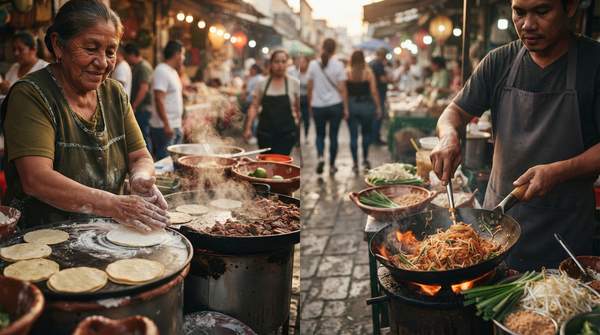
Street food is not fast food that happens to be outdoors — it is an edible archive. The taco in your hand and the noodle bowl you eat standing on a Bangkok sidewalk are direct products of what a region could grow, whom it traded with, and how its people moved through the day. Compare Mexico's corn-anchored street cooking with Thailand's rice-and-noodle tradition, and you can literally taste the difference between 9,000 years of Mesoamerican maize agriculture and centuries of wet-rice cultivation shaped by Chinese trade along the Gulf of Thailand.
Street Food as a Cultural Record: An Introduction
I've eaten my way through enough night markets and taquería lines to know that the best street food never feels invented. It feels inherited. That's because the dishes that matter culturally are endemic — they developed in, and are sustained by, a specific local tradition, rather than being merely convenient food sold outdoors. A Manhattan hot dog cart belongs to the first category, with a documented history in the city's immigrant economy reaching back to the 1860s; a multinational fast-food outlet with an open-air window belongs to the second.
That distinction matters, because it tells you where to look for the story. Food historically moved through slow networks of merchants, sailors, and migrant communities — pepper, tea, coffee, chillies, and sugar all became local through repeated contact rather than a single moment of arrival. Street food is where those long, patient journeys finally settled into something you can hold in one hand. The gap between an old rural method and its new urban context, as one analysis of global street food traditions puts it, is precisely where culinary fusion begins.
Foundational Agriculture: The Root of Regional Flavors
Start with the staple crop, because everything else follows from it. Mexican street food is overwhelmingly corn-based — tacos, tlayudas, tlacoyos, enfrijoladas — because Mesoamerican agriculture centered on maize for roughly 9,000 years, a timeline the Smithsonian Institution's National Museum of Natural History documents. The tortilla isn't a wrapper; it's the agricultural foundation of an entire civilization, pressed flat and griddled daily.
Thailand runs on a different engine. Thai street food is rice- and noodle-based, reflecting wet-rice cultivation and Chinese culinary influence built up over centuries of trade along the Gulf of Thailand. The noodle itself is a migrant: it arrived through sustained contact with Chinese culinary traditions and was absorbed so thoroughly that a stir-fried noodle dish now reads as quintessentially Thai. In both countries, the foundational crop dictated the grammar of street eating — what's wrapped, what's soaked, what travels well on a cart.