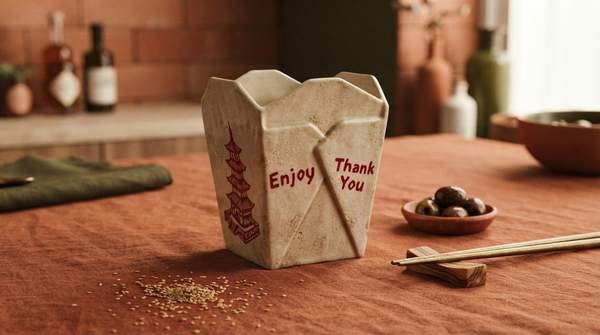
That folded paper box with the wire handle and the red pagoda? It is, as the Associated Press put it, "about as American as it gets." The Chinese takeout container was patented in Chicago in 1894 by inventor Frederick Weeks Wilcox — as a pail for carrying oysters. It never held food in China, and its manufacturer doesn't even sell it there. Yet somewhere between the oyster beds of the 1890s and your couch, this humble paper bucket became the world's visual shorthand for Chinese food.
The American Icon of Chinese Takeout
Sometimes there's a wire handle, sometimes a bright red pagoda graphic on the side — and inside, deliciousness. The container's story is a distinctly American blend of ingenuity, immigrant cultures becoming homegrown staples, and the desire for convenience, as the AP's Deepti Hajela describes it. The New York Times Magazine, examining the object in 2012, called it "a uniquely American invention," noting its Japanese-influenced origami folds. It has become so embedded in American life that it appears everywhere from Rush Hour and Dude, Where's My Car to Friends, The West Wing, and Gilmore Girls, and it has even been exhibited at New York's Museum of Food and Drink.
Humble Origins: From Oyster Pail to Patent
On November 13, 1894, in Chicago, Wilcox was granted a patent for what he called "a new and useful improvement" in pails used to carry oysters. His design was elegantly simple: a single piece of paper, creased into segments and folded into a more-or-less leakproof container, secured with a dainty wire handle on top. The folding gave the pail structural stability while limiting leaks, and it incorporated its own lid. Fresh oysters were more popular and plentiful then, and the paper pail was a cheap, disposable way to carry them home. Early patents for similar paper pails also date to 1890 and 1908, so Wilcox refined a broader wave of paper-pail innovation rather than inventing in a vacuum.