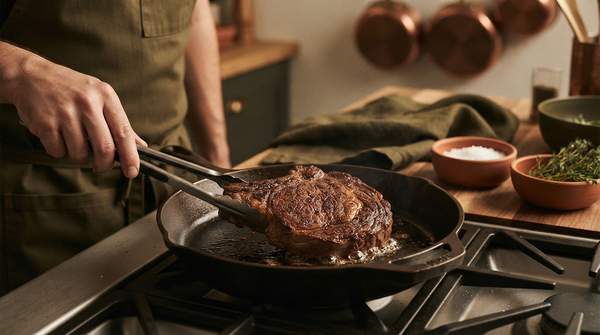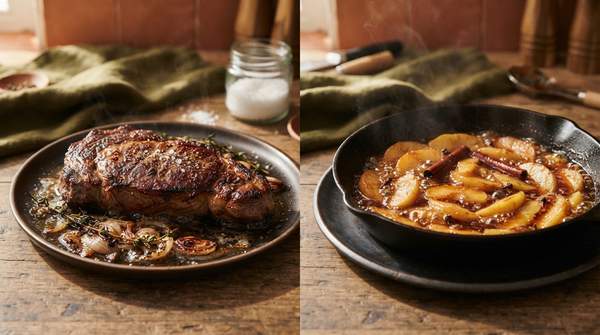
The difference comes down to chemistry: the Maillard reaction needs both sugars and amino acids from proteins, while caramelization is the thermal breakdown of sugar alone. That single distinction explains why a seared steak tastes savory and roasty while a pot of caramel tastes sweet and nutty — and knowing each reaction's trigger conditions lets you choose which one dominates your pan.
Introduction: The Science of Browning
Both reactions are non-enzymatic, meaning they're driven by heat rather than by enzymes like the browning that overtakes a cut apple. They're also easily confused because the results can look similar to the naked eye, as the Wikipedia entry on the Maillard reaction notes: both are promoted by heating, but the Maillard reaction involves amino acids whereas caramelization is the pyrolysis of certain sugars. The two can even run in parallel in the same dish — dairy caramels, for instance, host both at once. A piece by Yauheni Padniuk on Formul.io describes dairy caramels as a case where the reactions overlap from 110 °C onward, with the Maillard reaction dominating flavor up to about 160 °C and caramelization taking over above 165 °C. Understanding which reaction you're feeding is what separates guesswork from intentional cooking.
The Maillard Reaction: Savory Depth
The Maillard reaction begins when the reactive carbonyl group in a sugar molecule interacts with the nucleophilic amino group of an amino acid, as Dylan Hofer explains at Food Republic. The resulting unstable glycosylamine compound is rearranged — via the Amadori rearrangement — into ketosamines, which can then be rearranged in a wide variety of ways to produce a whole spectrum of flavors and odors. No amino acids, no Maillard: that's why the reaction flourishes in meats, bread, coffee, and roasted vegetables, where proteins and sugars coexist.
Temperature matters enormously. Food Republic places activation roughly between 285 and 300 °F (about 140–150 °C), and the Formul.io account agrees that Maillard products like pyrazines only become flavor-relevant above roughly 130 °C, running rapidly through 155–180 °C. Above 165 °C, melanoidins — large brown polymers — dominate, contributing color and bitter roasted notes.
Caramelization: Sweet Complexity
Caramelization is simpler in its ingredients but more demanding in its heat. It is the thermal decomposition of sugar alone — no protein required — and it starts at sugar-specific temperatures, roughly 110 °C for fructose and 160 °C for sucrose, according to the Formul.io piece. Food Republic similarly puts activation around 320 °F (160 °C) and above for typical sugar, while noting it can happen at 230 °F depending on the sugar. The process involves driving off water and breaking the sugar molecules down into new compounds. The sugar you choose therefore sets your starting line: fructose caramelizes far earlier than table sugar, which is why onions — rich in free sugars — can brown long before a sucrose syrup would.