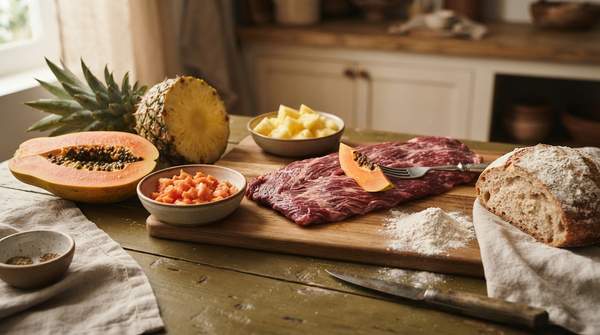
Here's the secret hiding in your fruit bowl and flour bin: papain from papaya and bromelain from pineapple are protein-dissolving machines that tenderize tough cuts of meat, while amylase in your flour quietly converts starch into the sugars that feed yeast and brown a crust. Once you understand what each enzyme attacks — protein in one case, starch in the other — you can predict, and control, the texture and flavor of what lands on your plate. The levers are the same for all three: time, temperature, and dose.
The Science of Culinary Enzymes: An Introduction
Enzymes are biological catalysts — proteins whose entire job is to speed up specific chemical reactions. In cooking, that specificity matters enormously, because each enzyme has a preferred target. The proteases go after other proteins, snipping long chains into shorter peptides and amino acids. Amylase, by contrast, is a starch specialist, chopping complex carbohydrates into simple sugars.
I find it helpful to think of enzymes as tiny, hyper-specialized kitchen assistants. Papain, a sulfhydryl protease extracted from the water-soluble portion of papaya latex, will rapidly hydrolyze a wide variety of proteins across a broad range of conditions, which is exactly why it has become one of the most extensively researched and commonly applied proteolytic enzymes in food processing. Bromelain is a whole group of protein-digesting enzymes found in the pineapple plant. Amylase, meanwhile, is the workhorse of baking and brewing, breaking down starches into fermentable sugars.
Two practical rules govern all of them. First, enzyme activity is time-, temperature-, and dosage-dependent — more enzyme, more time, or more warmth means more reaction. Second, each enzyme has an optimal temperature and pH range where it works fastest, and outside those windows it slows down or eventually deactivates. Those windows are your control panel.
Papain and Bromelain: Nature's Meat Tenderizers
Why does a tough cut turn silky after a fruit marinade? Because papain and bromelain are cysteine plant proteases that hydrolyze practically any protein found in muscle tissue, tendons, and ligaments. A scientific review of plant proteases in meat tenderization pinpoints their principal action sites: papain goes after myofibrillar protein and collagen, while bromelain's principal targets are collagen and myofibrillar protein. Collagen is the connective tissue that makes tough cuts chewy; myofibrillar protein is the muscle fiber itself. Dissolve enough of both and the meat relaxes.
The two enzymes differ in their comfort zones. According to the comparative data, papain stays active across 40–80°C, with peak performance at 60–75°C and an optimal pH of 6.0–7.0. Bromelain works across 50–80°C, peaking at 50–65°C, with an optimal pH of 6.0–8.5. That temperature detail is genuinely useful: these enzymes keep working as the meat cooks, not just while it sits in the marinade.
But there is such a thing as too much of a good enzyme. A comparison of cysteine plant proteases lists papain's disadvantages bluntly: over-tenderization, a mushy texture, and the production of off-flavours. The same review notes papain is not used for premium quality meat products, because enzymatic proteolysis can form bitter peptides, reduce juiciness, and leave a perceived bitterness. Bromelain deserves the same respect — leave either one on too long and you're eating meat-flavored baby food.